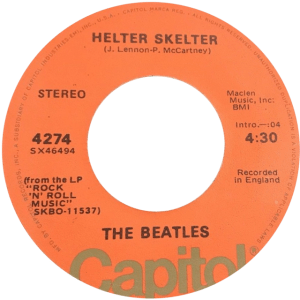
Few debates in rock history ignite as much passion as the question: What was the first heavy metal song? While there isn’t a universally agreed-upon answer, one track is almost always brought into the conversation, The Beatles’ “Helter Skelter” (1968). Written by Paul McCartney and featured on the White Album, the song was a deliberate attempt to create something heavier and more chaotic than anything else on the charts at the time. Its screaming vocals, distorted guitars, and relentless drumming earned it the reputation of being one of the earliest proto-metal tracks.
Yet, while Helter Skelter stands as a cornerstone, it is only part of a larger mosaic. The development of heavy metal was evolutionary, with multiple songs and artists across the 1950s and 1960s contributing vital pieces to the genre’s DNA. To appreciate the Beatles’ role, one must also look at the broader landscape of aggressive, distorted, and theatrical music that paved the way for Black Sabbath’s official christening of heavy metal in 1970.
Why Helter Skelter Matters
Paul McCartney’s Intent: The song wasn’t an accident. After reading a review that described The Who’s “I Can See for Miles” as the loudest, dirtiest rock song yet, McCartney set out to top it. The result was “Helter Skelter,” a track built on chaos, volume, and distortion—qualities alien to pop music of the time.
Key Characteristics:
Heavy Distortion:
George Harrison and McCartney leaned into raw, buzzing guitar tones that foreshadowed the crunch of 1970s metal.
Aggressive Riffs & Drums:
Ringo Starr hammered the kit with ferocity, reportedly yelling at the end of the recording, “I’ve got blisters on my fingers!”—a perfect testament to the song’s intensity.
Screamy Vocals:
McCartney’s voice shifted from raspy snarls to guttural screams, a style far closer to Robert Plant or even early metal vocalists than to his usual pop balladry.
Raw Energy:
The entire track sounds almost out of control, with feedback, distortion, and a frenzied performance that creates a sonic blueprint later expanded by hard rock and metal bands.
Influence & Legacy:
- Widely covered by artists like Aerosmith, U2, and Mötley Crüe, “Helter Skelter” continues to inspire musicians across genres.
- Critics place it in both the proto-metal and proto-punk camps, given its anarchic delivery.
- It shifted perceptions of what The Beatles could do and proved that pop’s most famous band could be pioneers of heaviness.
John Lennon’s Claim: Ticket to Ride (1965)
In a 1980 interview, John Lennon called Ticket to Ride “one of the first heavy-metal records.” While the song doesn’t sound like heavy metal by today’s standards, Lennon’s remark reveals how “heaviness” was perceived in the mid-1960s.
Why Lennon Saw It as Heavy:
- Ringo’s Drumming: A pounding, repetitive rhythm gave the song a thudding weight.
- Driving Guitars: The jangly riff was simple yet forceful, standing out against the lighter textures of early ’60s pop.
- Breaking Pop Norms: At over three minutes, it stretched past the typical radio-friendly runtime of the era.
Why It’s Not Quite Metal:
- By modern standards, the track lacks the distortion and aggression necessary for heavy metal classification.
Still, it foreshadowed a shift away from clean pop into heavier territory. - Some argue I Want You (She’s So Heavy) (1969) is an even stronger candidate for a proto-metal Beatles track, with its relentless riff and suffocating repetition—echoes of doom metal before the term existed.
Proto-Metal Trailblazers Beyond Helter Skelter
While The Beatles played a central role, other artists were experimenting with the same ingredients that would eventually form heavy metal.
1950s Foundations
Screamin’ Jay Hawkins – I Put a Spell on You (1956):
Originally meant as a ballad, the drunken recording session produced screams, grunts, and guttural howls. It shocked audiences and introduced horror theatrics that later inspired Alice Cooper, Marilyn Manson, and Rob Zombie.
Link Wray – Rumble (1958):
With its distorted power chords and menacing instrumental style, Rumble was banned from some radio stations for sounding “too dangerous.” Its raw guitar tone would become a bedrock of rock heaviness.
1960s Experiments:
Dick Dale – Miserlou (1962):
Known as the “King of Surf Guitar,” Dale pioneered rapid picking and extreme volume, directly influencing the shred techniques of later metal guitarists.
The Kinks – You Really Got Me (1964):
Dave Davies slashed his amplifier speaker to create distortion, delivering a riff so primal that it became the DNA of hard rock and proto-metal.
The Who – My Generation (1965) / I Can See for Miles (1967):
Pete Townshend’s windmill guitar slashes and Keith Moon’s explosive drumming pushed rock toward chaos and volume.
Jimi Hendrix – Stone Free (1966) and Voodoo Child (1968):
Hendrix revolutionized distortion, feedback, and wah-wah effects, setting technical benchmarks for heavy guitar playing.
Steppenwolf – Born to Be Wild (1968):
Famous for the lyric “heavy metal thunder,” it gave the genre its name while combining rebellion, motorcycles, and aggressive rock sound.
Iron Butterfly – In-A-Gadda-Da-Vida (1968):
At 17 minutes long, it featured heavy organ riffs, dark tones, and proto-doom atmospheres, influencing Sabbath and stoner rock.
Arthur Brown – Fire (1968):
With its manic vocals and theatrical pyrotechnics, Brown helped set the stage for metal’s love of spectacle.
Deep Purple – Wring That Neck (1968):
Complex, riff-heavy, and aggressive, this track planted the seeds for Deep Purple’s evolution into one of metal’s founding bands.
The Moment of Birth: Black Sabbath
Despite all these contenders, many historians argue that heavy metal truly began on February 13, 1970, when Black Sabbath released their self-titled debut album. The track Black Sabbath itself—featuring a slow, crushing tritone riff known as “the Devil’s Interval”—brought together darkness, heaviness, and thematic intent in a way no one had before.
Why Sabbath Solidified Metal:
- The riffs were heavier and darker than anything prior.
- Lyrics embraced occult imagery and doom-laden storytelling.
- The atmosphere was oppressive and theatrical, defining the aesthetic of heavy metal.
While earlier songs hinted at or flirted with heaviness, Black Sabbath made it a genre.
Was Helter Skelter a Metal Song?
Helter Skelter remains one of the most crucial proto-metal songs. It was born from The Beatles’ desire to push boundaries, and in doing so, it laid down a chaotic, distorted foundation for the genre to come. But it wasn’t alone.
From Screamin’ Jay Hawkins’ guttural theatrics in the 1950s, to Dick Dale’s rapid-fire surf guitar, to The Who’s destruction of stage and sound barriers, to Steppenwolf giving the world the term “heavy metal,” the path to Sabbath was paved by many artists across two decades.
So was Helter Skelter the first heavy metal song? Perhaps not definitively, but it was undeniably one of the loudest warning shots fired before the arrival of true metal. Instead of a single spark, heavy metal was born from a roaring firestorm of innovation, rebellion, and noise that changed rock music forever.
