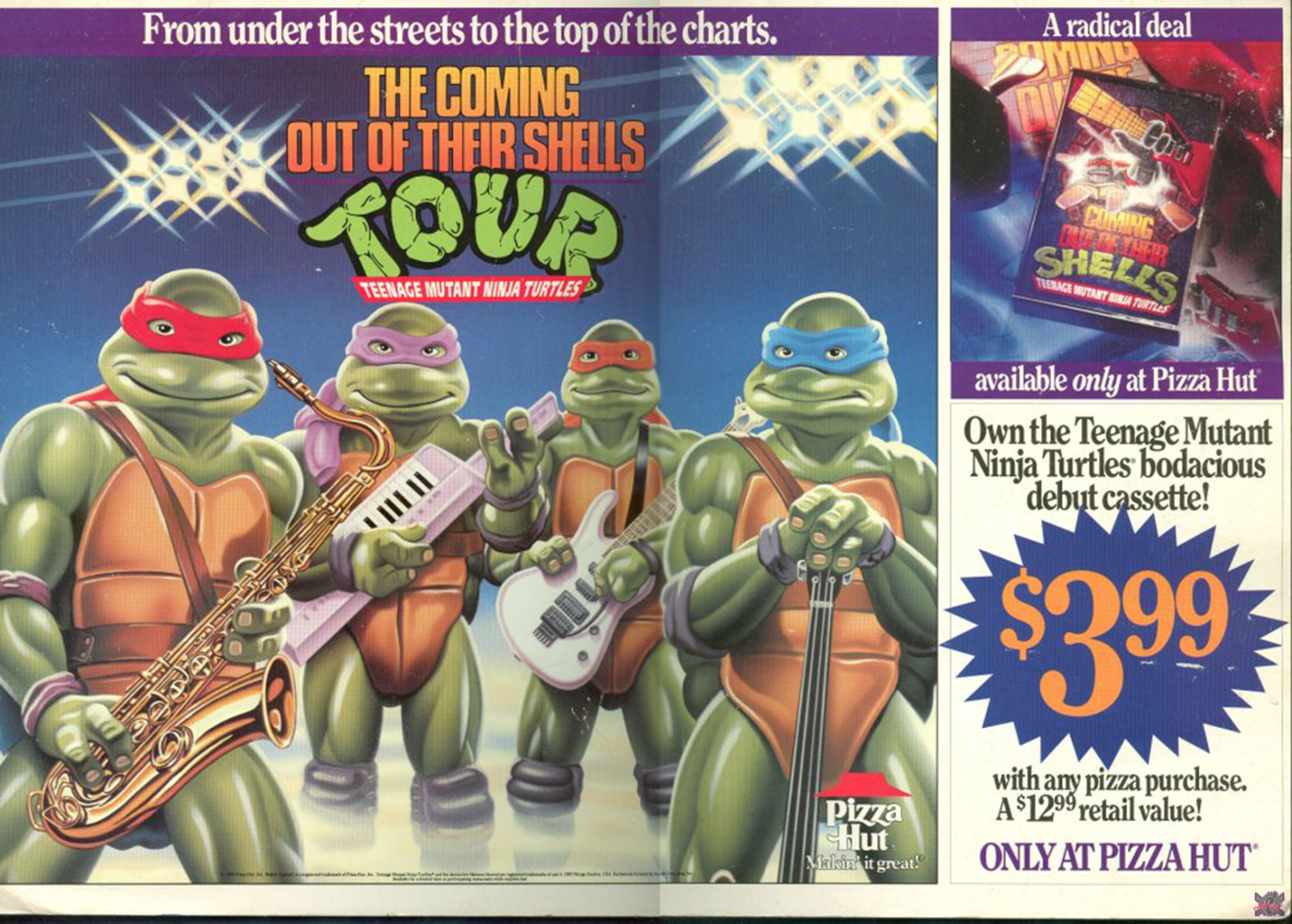
In 1990, at the height of the franchise’s commercial dominance, Coming Out of Their Shells represented an ambitious extension of the Teenage Mutant Ninja Turtles brand into recorded music and live performance. What could have functioned merely as a merchandising vehicle instead emerged as a carefully constructed pop-rock album with a defined sonic identity and a clear understanding of its audience.
Conceived as both a studio album and a companion to a national arena tour, the record operates within a fully sustained fictional premise: Leonardo, Michelangelo, Donatello, and Raphael are not only martial artists and crime fighters, but a performing band. The album does not parody this idea. It embraces it with directness and structural discipline. That commitment gives the project cohesion and credibility within its intended framework.
The Ninja Turtles and their Production
The album’s production reflects late-1980s arena pop aesthetics. There’s polished drum programming, tightly compressed electric guitars, layered synthesizers, and prominent vocal harmonies. The arrangements are engineered for clarity and projection, suggesting equal consideration for studio playback and large-scale live reinforcement. The vocal performances are shaped to function musically, prioritizing pitch stability, blend, and chorus impact.
Track by Track Analysis
1. Coming Out of Our Shells
The title track serves as the thematic foundation. Structured around a mid-tempo rock progression, it builds methodically toward a broad, participatory chorus. Ninja Turtle Raphael uses this as a lyrical metaphor, emerging from one’s shell, as both a literal reference and a symbolic statement of creative self-expression. The composition follows a classic verse–pre-chorus–chorus form, with a melodic contour designed for memorability rather than complexity. As an opener, it establishes the tone of the whole album and live show. It’s confident, communal, and energetic.
2. Sing About It
This composition centers explicitly on music as a vehicle for expression. The rhythm section incorporates subtle syncopation, creating a slightly more kinetic undercurrent than earlier tracks. Lyrically, it articulates the album’s implicit thesis: that performance and song function as tools for empowerment and emotional processing.
3. Tubin’
“Tubin’” introduces a lighter rhythmic feel, drawing on Dick Dale-inspired surf-rock elements and relaxed tempo shifts. The guitar work is less aggressive, favoring brightness over density. The track enhances the album’s sonic diversity through a unique fusion of surf rock and rap elements. This variation contributes to the overarching optimism of the record. It is a fitting choice for four teenage turtles from New York to perform a song centered around surfing.
4. Skipping Stones
As one of the more reflective parts of the album, “Skipping Stones” takes on a more melodic approach. Rather than the ninja turtles performing this number, the turtles invite their Master Splinter to take the spotlight. The instrumentation softens slightly, introducing sustained synth textures beneath steady percussion. It might be said that this song was influenced by Bruce Springsteen and Jon Bon Jovi’s melodic ballads. The metaphor of rippling consequences, whether good or bad, situates the song within broader youth-oriented coming-of-age themes. Its measured pacing provides contrast within the tracklist and demonstrates the album’s tonal range.
5. Pizza Power
“Pizza Power” stands out as a recognizable composition. Driven by a concise guitar motif and brisk rhythmic pacing, the track relies on repetition and chant-based phrasing to create impact. It’s very much obvious this song was written by the turtles with a deep appreciation for their favorite food.
While the subject matter is playful, the arrangement is disciplined. The chorus is constructed for durability—short, declarative lines supported by tight rhythmic alignment of the bass guitar. The song’s effectiveness lies in its refusal to treat its theme as novelty. It is performed with conviction rather than irony.
6. Walk Straight
This song explores moral themes and includes a semi-autobiographical element, briefly discussing the turtles’ mutations. The tempo moderates, allowing lyrical emphasis on integrity and personal responsibility. Hence why the message of the song would be to “Walk straight, you don’t need to mutate”. Harmonically, the progression favors upward resolution, reinforcing its aspirational tone. Layered vocal harmonies in the chorus provide emotional weight without excess sentimentality. The production remains restrained, allowing the message to remain central.
7. No Treaties
“No Treaties” introduces a firmer rhythmic stance compared to the preceding tracks. The song’s Quiet Riot- like arrangement emphasizes determination and resolve, reflected in its more assertive vocal delivery and guitar presence. Thematically, the lyrics focus on standing firm against adversity and refusing compromise when principles are at stake. Within the album’s broader context, it represents a moment of increased narrative intensity and resolve.
8. Cowabunga
“Cowabunga” stands out as one of the most energetic tracks on the record, as it introduces each of the turtles and highlights their distinct personalities. Performed by the orange-masked turtle, Michelangelo, the song features a mix of funk and rap elements, emphasizing a strong rhythmic drive and a chant-based chorus.
The track effectively captures the celebratory spirit associated with the Turtles’ iconic catchphrase. It also demonstrates a creative approach to musical composition, particularly through Michelangelo’s lyrics, “Gotta keep rapping, gotta keep talking.” Notably, he pauses for four beats before concluding the verse with “Ready to go,” illustrating his anticipation and enthusiasm for continuing both the rap and dialogue.
While musically straightforward, its high energy and rhythmic clarity make it well-suited to live performance environments.
9. April’s Ballad
This particular entry introduces a softer tone to the album, featuring guest vocals by April O’Neil. The instrumentation is intentionally minimal, which allows her vocal clarity to take center stage within the arrangement.
The track effectively conveys her sincerity and courage in the face of Shredder’s mission to undermine the music of the world. This focus on personal connection rather than spectacle enriches the overall narrative of the album.
10. Count On Us
This being the final entry of the album, constructedConstructed as a unity anthem, “Count On Us” emphasizes collective reassurance. The chorus employs call-and-response phrasing suitable for live participation, supported by layered harmonies and steady percussion.
The arrangement is formulaic in structure but effective in execution. Its emphasis on reliability and solidarity reinforces the album’s recurring thematic core.
Cohesion and Intent
What distinguishes Coming Out of Their Shells is not innovation but internal consistency. The record maintains tonal discipline across its runtime. It neither undermines its premise nor indulges in self-conscious humor. Instead, it delivers a unified pop statement calibrated for youth audiences and family accessibility. The Ninja Turtles’ parallel arena tour extended its theatrical dimension, translating studio material into staged performance. While reception to the live production varied, the scale of execution reflected considerable ambition.
Final Evaluation
Coming Out of Our Shells is not a transformative work within the broader rock canon. It does not pursue experimentation or technical virtuosity. Its goals are more focused: accessibility, cohesion, and thematic reinforcement of its source material.
Within those parameters, it succeeds. The songwriting is concise, the production controlled, and the tone unwaveringly sincere. The Ninja Turtles remain a notable example of disciplined franchise expansion executed through the language of late-20th-century pop rock.
Rating: 4 out of 5
This album is a cohesive artifact, both commercially and musically, that reflects its cultural moment.
This content was created with the assistance of artificial intelligence tools and has been reviewed and edited by our team for accuracy and quality.
